

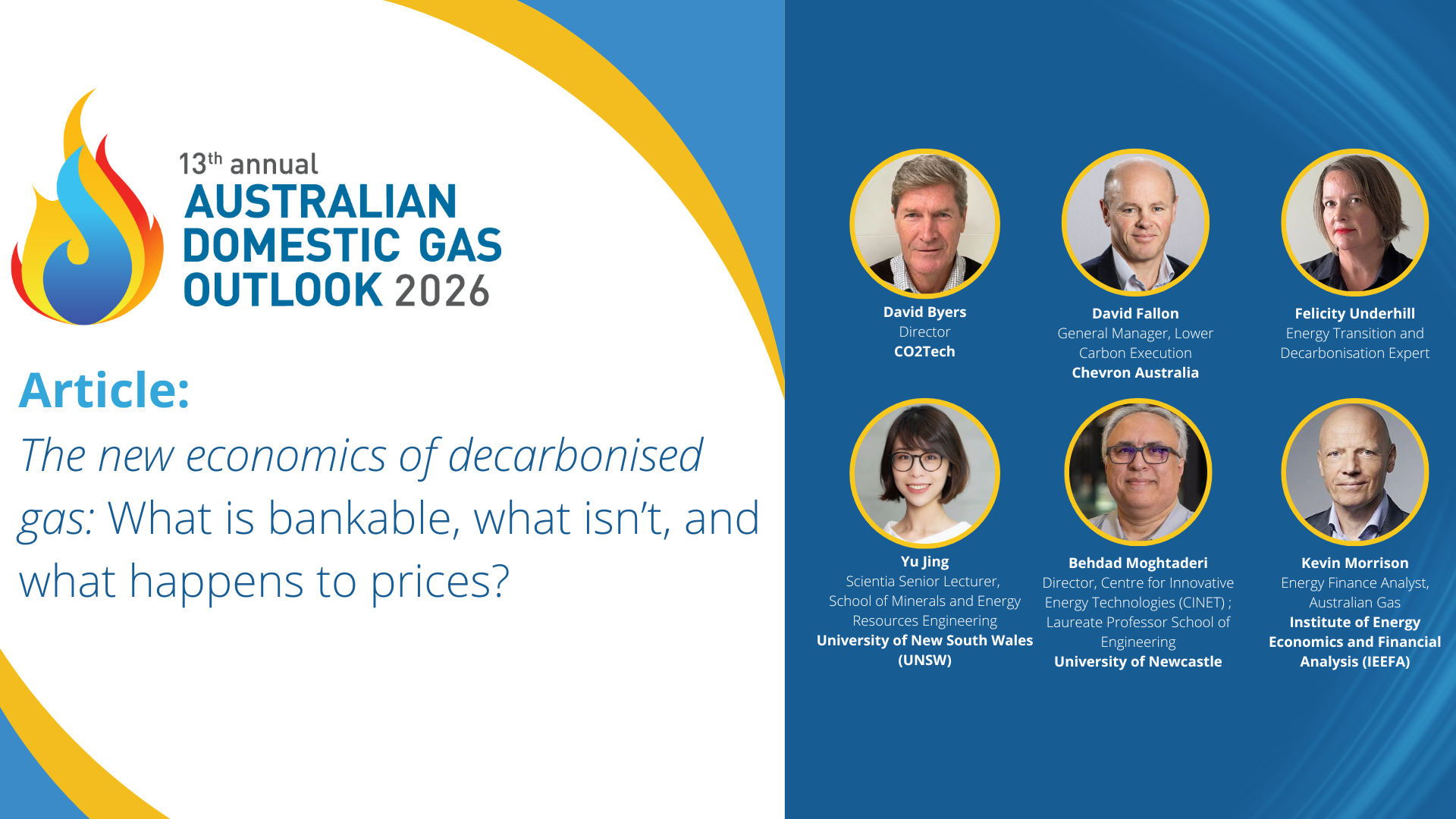
By Kirstin Crothers
Across Australia’s gas sector, decarbonisation has shifted from a long-term aspiration to an immediate commercial challenge. Producers are weighing capital allocation decisions, regulators are tightening compliance frameworks, and large industrial users are assessing cost exposure in an increasingly volatile market. What remains unresolved is how decarbonisation targets translate into bankable investments — and who ultimately pays.
Rather than a single pathway, the emerging picture is fragmented, shaped by technology choices, regulatory settings and the hard realities of cost and demand.
The future role of gas in a decarbonising energy system
Gas continues to play a central role in Australia’s energy mix, particularly outside the electricity sector. While renewable generation has expanded rapidly, electricity represents only a portion of final energy demand. Industrial heat, feedstocks and transport fuels remain heavily reliant on gas and other hydrocarbons.
David Byers, Director of CO2Tech, argues that this reality is increasingly acknowledged globally. After a decade dominated by emissions targets, he sees a “more pragmatic global reassessment” underway, one that restores energy security and affordability as core objectives. In his view, “vast quantities of affordable natural gas and other fossil fuels will still be required well into this century”, even as their share gradually declines.
“decarbonisation adds capital and operating expenses that are inevitably paid by end users”
That persistence, however, does not insulate gas from pressure. Yu Jing, Scientia Senior Lecturer at UNSW, notes that decarbonised gas delivers emissions benefits “but at a higher cost”. For producers, she says, decarbonisation adds capital and operating expenses that are “inevitably paid by end users”. This cost pass-through raises questions about demand resilience, particularly in price-sensitive domestic markets.
Felicity Underhill frames the issue more starkly. Wherever electrification is feasible, she argues, it will increasingly dominate. “Wherever we can electrify with renewable electricity, we should,” she says, pointing to faster cost declines and greater investor confidence. In this context, gas’s future is likely to be more selective — focused on uses where alternatives remain limited or prohibitively expensive.
Carbon Capture and Storage (CCS) as a central—but contested—abatement pathway
As the long-term role of gas is increasingly recognised, attention turns from eliminating its use to reducing the emissions associated with it. Carbon Capture and Storage has become one of the most prominent — and debated — tools in that effort.
From an industry perspective, Australia is often seen as well positioned. David Fallon, General Manager of Lower Carbon Execution at Chevron Australia, highlights the country’s “advantaged geology and stable regulatory frameworks” as foundations for a domestic CCS industry that could also support regional decarbonisation efforts across the Asia-Pacific.
“One of the most effective ways to expand the potential for CCS and reduce costs is increasing the economies of scale of projects through developing multi-user hubs”
Fallon emphasises scale as the critical factor. “One of the most effective ways to expand the potential for CCS and reduce costs is increasing the economies of scale of projects through developing multi-user hubs,” he says. Broadening the customer base beyond LNG operators to include “hard-to-abate industries such as steel, cement, and chemical production” is central to that strategy.
Yet CCS economics remain challenging. Professor Behdad Moghtaderi from the University of Newcastle notes that while CCS can offer “up to 90% CO₂ abatement”, costs are substantial, typically ranging from US$35 to US$105 per tonne captured, with capital intensity highly dependent on plant scale.
Critics question whether CCS delivers sufficient system-wide impact. Kevin Morrison from IEEFA argues that CCS “will do little to reduce emissions” if it focuses primarily on reservoir emissions, which he estimates account for “less than 10% of total emissions associated with gas supply and use”. From this perspective, CCS risks being a partial solution unless accompanied by broader methane and downstream emissions controls.
Economics and investment realism over transition narratives
Across all pathways, one theme consistently emerges: capital discipline. Transition narratives alone are no longer sufficient to unlock investment.
“low-carbon gas has been promoted as the next big thing for over a decade, yet uptake remains limited”
Underhill observes that renewable and low-carbon gas has been promoted as “the next big thing” for over a decade, yet uptake remains limited for largely economic reasons. To attract capital, she argues, low-carbon gas must be genuinely low- or zero-emissions and deployed only in “disciplined, high-value use cases” such as industrial feedstocks, some biofuels and a limited firming role.
Moghtaderi’s analysis reinforces this selectivity. Hydrogen blending, often framed as a low-regret option, “significantly increases costs, particularly at higher blend ratios”, even if existing infrastructure can mitigate some expenses. Renewable natural gas, especially from organic feedstocks, remains more expensive than conventional gas, though he notes its cost trajectory is declining in regions with strong policy incentives.
Byers challenges the assumption that renewables will rapidly displace hydrocarbons across the energy system. Despite trillions in global public spending, he points to slow gains in renewables’ share of final energy consumption and argues that this is “not the trajectory of an unstoppable revolution”. In that context, he positions CCS not as a temporary bridge, but as a “core emissions-reduction tool” aligned with demand realities rather than ideology.
Limits of green premiums, offsets, and policy-driven markets
A critical commercial question for gas producers and users is whether decarbonised gas can command a price premium. Here, scepticism is widespread.
“carbon-neutral LNG will unlikely command a premium unless buyers face reputational pressure or binding emissions compliance”
Yu Jing argues that “carbon-neutral LNG will unlikely command a premium” unless buyers face reputational pressure or binding emissions compliance. Without “strong regulatory drivers or targeted government incentives”, she suggests, decarbonised gas struggles to compete with conventional supply. Clear compliance obligations, shared infrastructure and reliable carbon pricing are, in her view, necessary to incentivise investment across the supply chain.
Morrison takes a similar stance, stating that “aside from biomethane, it is hard to see how LNG or domestic gas products can command a premium”. He also raises concerns about under-reporting of methane emissions and over-reliance on offsets. While mechanisms such as the Safeguard Mechanism oversee compliance, he argues that “carbon offsets alone are not sufficient” to meet Australia’s emissions targets, calling for stricter rules on direct emissions reduction.
“cost competitiveness will remain decisive”
Byers agrees that expectations of sustained green premiums are fading. In LNG and domestic gas markets, he argues, “cost competitiveness will remain decisive”, echoing the experience of ESG-labelled commodities where price premiums have proven difficult to sustain.
A more constrained, more commercial phase
Taken together, these perspectives suggest Australia’s gas sector is entering a more constrained and commercially grounded phase. Gas is likely to remain part of the energy system, but its role is narrowing. CCS is gaining prominence, but under closer scrutiny. Capital is increasingly selective, and price premiums for decarbonisation are far from guaranteed.
For senior gas professionals, the challenge is less about declaring transition intent and more about navigating the practical economics of what is investable, defensible and affordable.